
Bay Windows and Bow Windows
A bay window projects beyond the main wall of the house, adding floor space, light from more than one direction and a view along the street as well as straight ahead. Bays are a defining feature of many Victorian, Edwardian and 1930s homes, and they bring their own challenges when the time comes for new glazing. Sean Cardwell Windows supplies uPVC windows from our Weston-super-Mare base, and this page explains bay and bow designs in general terms so you know what to ask about when planning a bay window replacement.
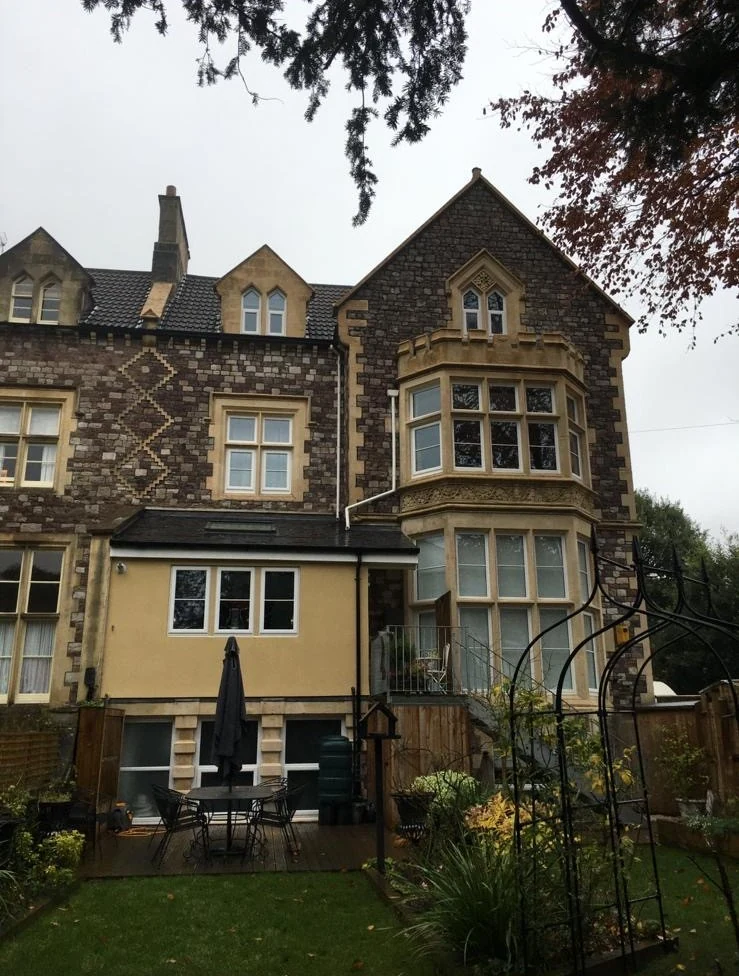
Bay window types
The most familiar shape is the canted bay, with a wide centre window and two angled side windows, usually at around 45 degrees. A box or square bay has side windows set at right angles to the front, giving a more rectangular projection. Splayed and oriel bays are variations found on particular house styles, an oriel being a bay on an upper floor that does not reach the ground. A bow window is a gentle curve made of several narrower windows, typically four to six, joined at shallow angles to form an arc.
Each type can be made as a set of casements, with opening and fixed panes chosen to suit the room, and in some cases with a sliding sash look on period homes.
Bay window replacement
Replacing a bay is more involved than replacing a flat window. The joints between the sections, where the frames meet at an angle, need strong couplers and careful sealing. On many older houses the bay frames also help hold up the structure above, such as a small roof or the brickwork of an upper bay. If that load has been carried by the original window frames, it has to be properly supported before and after the old frames come out. A survey therefore looks closely at what sits above the bay, the condition of the lintel or bay roof and whether extra support posts are needed.
Bay window installation and measuring
Accurate measuring is everything with a bay. Small errors in angles add up across the sections, and the result is a frame that will not seal neatly. Installation involves removing the old frames section by section while the structure is supported, fitting the new frames and couplers, then sealing inside and out and making good the boards and sill. Internal window boards often need replacing too, as the old ones rarely survive removal.
Bow windows
A bow window gives a softer, rounded look and suits some period and cottage-style properties. Because it is made from more sections than a bay, the number of joints is higher, so neat coupling matters even more. Bows can be built with fewer opening sashes to keep the curve clean, or with more vents where ventilation is needed.
Bay window repair
Not every tired bay needs replacing. Hinges, handles and seals on bay casements can be renewed like those on flat windows, and a failed glass unit can be swapped in one section only. Where the frames are sagging or the roof above is leaking, though, the cause needs to be understood first. For general repair work see uPVC window repairs.
Planning your bay
Choosing the best bay windows for your home is mostly about matching the shape and sightlines to the house and making sure the structure is supported. Read our uPVC windows page for frame options, and the window replacement cost guide for what influences a quote. Then send a photo of the bay through the quote form.
Relevant services
Get Free QuoteFrequently asked questions
What types of bay window are there?
The main types are canted bays with angled sides, box or square bays, splayed bays and oriel bays on upper floors. A bow window is a related curved design made of several narrow sections.
What is the difference between a bay and a bow window?
A bay has distinct angled or square sides, while a bow forms a gentle curve from several narrower windows joined at shallow angles.
Do bay windows support the structure above them?
On some older houses they do. That is why a survey checks what sits above the bay and whether extra support is needed before replacement.
Can one section of a bay be replaced on its own?
Often a single glass unit or opening sash can be renewed without replacing the whole bay, provided the frames are in good condition.